Built on Districtr
The mapping tool you're using is a self-hosted instance of Districtr, an open-source web application developed by the MGGG Redistricting Lab (now the Data and Democracy Lab). Redistricting Partners runs this deployment under our own infrastructure for our California redistricting work, but the software, the science, and the public-engagement model behind it are theirs. This page is a thank-you and a brief history.
Origins: Lowell, 2018
Districtr did not start as a software product. It started as a question from civil-rights lawyers in Boston: how does a community get its voice into the redistricting process when the people drawing the lines don't live there?
Lawyers for Civil Rights, the Boston arm of the national Lawyers' Committee for Civil Rights Under Law, was working with residents of Lowell, Massachusetts, who were frustrated about not having a voice in their city council. In conversations with community members, the same places kept coming up — Clemente Park, a much-loved meeting point for the city's Asian and Latinx populations that felt unsafe at night because the city had not provided lighting; Lowell High School, the city's only public high school, slated to be moved without sufficient outreach to surrounding communities. People knew exactly which streets and neighborhoods mattered to them. They lacked a way to put that knowledge in front of the line-drawers.
In the summer of 2018, a student team at the MGGG Redistricting Lab — then based at Tufts University — sketched out a tool whose fundamental principle was, in the team's words, to ask the community what matters. The first Districtr engagement went live in 2019 and was used in Lowell that same cycle. From a student summer project, it grew into public infrastructure.
Moon Duchin and the Mathematics of Fair Maps
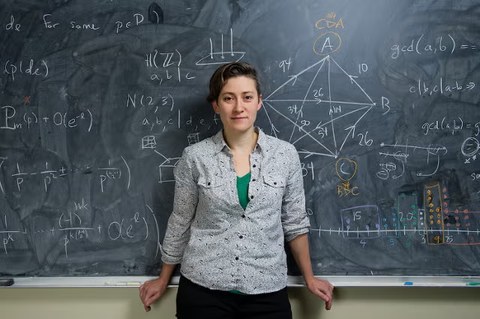
Districtr's founding home is the research group that Moon Duchin built. Dr. Duchin is a mathematician — a Harvard undergraduate (math and women's studies, 1998), a University of Chicago Ph.D. in geometric group theory (2005, advised by Alex Eskin), and a faculty member at Tufts from 2011 through 2024 before moving to the Brooks School at Cornell and then to the University of Chicago. Her core research is in geometric topology and Teichmüller theory: deep, abstract mathematics with no obvious connection to American politics.
And then she made the connection. In 2016, Duchin founded the Metric Geometry and Gerrymandering Group (MGGG) at Tufts to put serious mathematics to work on the question of whether districting plans are fair. The lab pioneered the use of Markov chain Monte Carlo ensemble methods — a technique borrowed from statistical mechanics — to compare a given map against a baseline of millions of computer-generated alternatives drawn under the same legal constraints. This is now the standard mathematical apparatus that courts use to evaluate gerrymandering claims. Duchin did not invent it alone, but her group made it usable, defensible, and visible.
The recognitions came quickly:
- Fellow of the American Mathematical Society (2016) — "for contributions to geometric group theory and Teichmüller theory, and for service to the mathematical community."
- Mathematical Association of America Distinguished Lecturer (2016).
- Guggenheim Fellow (2018) — supporting her work on political geometry and the mathematics of redistricting.
Beyond the awards, Duchin has been an expert witness in some of the most consequential redistricting cases of the last decade. In 2018, after Pennsylvania's Supreme Court struck down the state's congressional map as an unconstitutional partisan gerrymander, Governor Tom Wolf brought her in to evaluate the replacement maps. In 2022, after federal judges rejected Alabama's congressional plan in Allen v. Milligan, she produced four alternative maps demonstrating that a second Black-majority district was geographically and demographically feasible. She also runs a summer training program — the Voting Rights Data Institute — that has prepared a generation of mathematicians to serve as expert witnesses in redistricting litigation.
In 2024 the lab moved with Duchin from Tufts to Cornell's Brooks School of Public Policy. In 2025 it moved again, to the University of Chicago, where it now operates as the Data and Democracy Lab. The mission has not changed.
Where Districtr Has Been Used
Since launching publicly in 2019, Districtr has been the official public-engagement tool in jurisdictions across the country. A short, incomplete list:
- The Wisconsin People's Maps Commission used Districtr as its official map-collection tool during the 2020-cycle redistricting process.
- The Michigan Independent Citizens Redistricting Commission contracted with the team to support public mapping input during Michigan's first citizens-commission-led redistricting.
- Major cities including New York City, Los Angeles, San Diego, and Minneapolis have run Districtr-based public engagements.
- Smaller jurisdictions down to Grand County, Utah (population 9,669) have used the same tool. The technology scales from a metropolis to a town.
- Across California, the team has supported community mapping in places like Sonoma, Healdsburg, Gilroy, Foster City, Belmont, Carpinteria, and many more.
"Participating in the redistricting process should be approachable for everyone."
— Districtr's stated values
That sentence is the entire point. The redistricting process should not require a GIS workstation, a $5,000/year ArcGIS license, or a degree in political science. Districtr put redistricting in a browser, free, no login, no downloads, on a tablet or a phone or a public-library computer. It set a new floor for what public engagement infrastructure could be.
The Team
Districtr is the work of many hands. The core development team has included Liz Kopecky (project manager), Max Hully and Ruth Buck (the originating team), and an extended group of contributors: Jamie Atlas, Eion Blanchard, Jack Deschler, Nick Doiron, Moon Duchin, Chris Gernon, Peter Horvath, Muniba Khan, Zhenghong Lieu, JN Matthews, Anthony Pizzimenti, Heather Rosenfeld, Anna Schall, and many others. The work has been done in partnership with civil-rights and democracy-reform organizations including Common Cause, MALDEF, the Brennan Center, the Lawyers' Committee for Civil Rights Under Law, the NAACP Legal Defense Fund, and many more.
License, Credit, and What This Page Is For
Districtr is published under permissive open-source licenses — the frontend under the MIT License, the supporting backend under the 3-Clause BSD License. Both allow self-hosting, modification, and commercial use, provided the original copyright notice is preserved.
Redistricting Partners runs this instance because we serve California cities and want the operational control, integration, and turnaround time that come with hosting our own infrastructure. That is exactly the use case the licenses contemplate.
We did not build the science. We did not build the original tool. We are standing on the work of MGGG and the Data and Democracy Lab. Where you see a Districtr-based public engagement run by Redistricting Partners, please understand that the underlying platform is theirs and the public good it produces is built on years of their effort.
mggg.org · data-democracy.org · github.com/districtr/districtr